
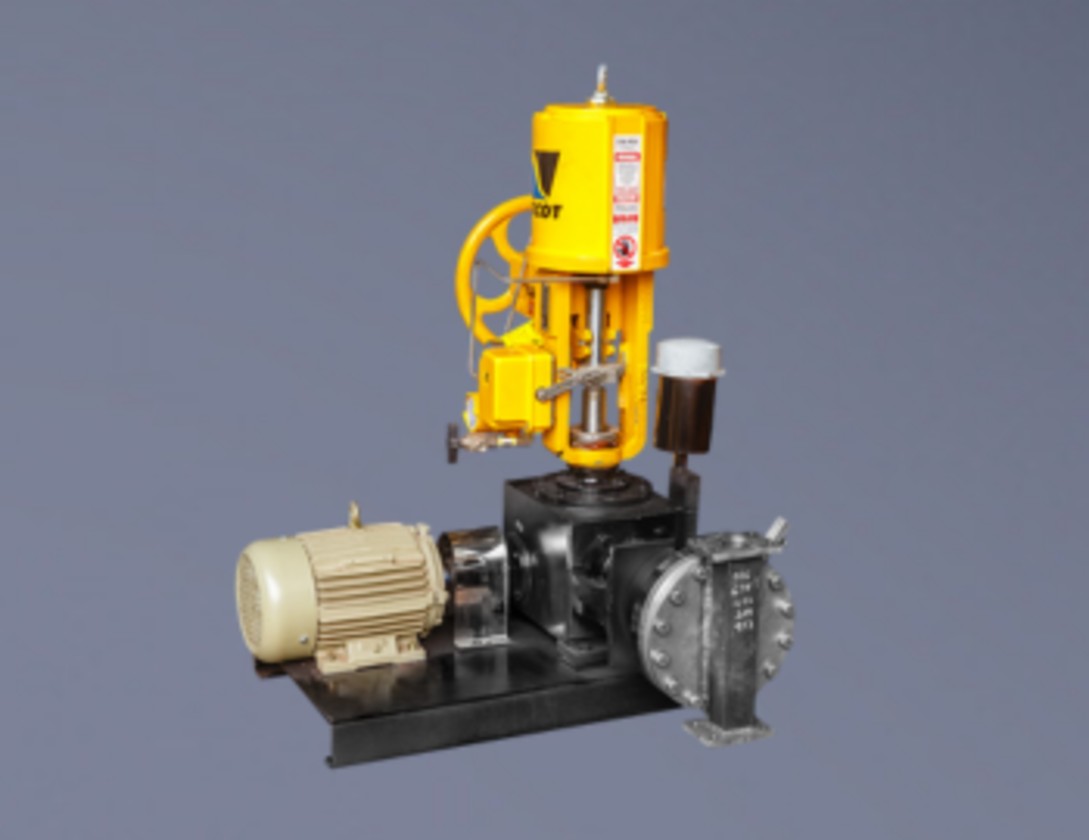
What Are Dosing Pump Control Modes?
Dosing pump control modes determine how a pump starts, stops, and adjusts the quantity or rate of chemical delivered into a process.
Depending on the pump model and controller, the dosing rate can be adjusted manually, through an electrical signal, in response to incoming pulses, or according to a predefined batch quantity.
Selecting the appropriate control mode helps improve chemical consumption, process stability, automation, and dosing consistency.
1. Manual Control Mode
Manual control is one of the simplest ways to operate a dosing pump. The operator sets the required dosing rate or pump stroke frequency using the available controls on the pump or its controller.
Once configured, the pump operates at the selected setting until the operator changes it or the pump is stopped.
How Does Manual Dosing Work?
In manual mode, the operator adjusts the pump output according to the required chemical dosing rate. Depending on the pump design, this may involve setting the flow rate, stroke frequency, or stroke length.
For example, an operator may set a dosing pump to deliver 5 litres per hour for a process that requires a relatively consistent chemical feed.
Advantages of Manual Control
Simple operation and adjustment.
Suitable for basic dosing applications.
Lower automation requirements.
Useful for commissioning, testing, and applications with stable chemical demand.
Common Applications
Manual dosing is commonly used in small water treatment systems, laboratory setups, and industrial processes where the required chemical feed remains relatively constant.
Limitation: Manual control does not automatically adjust the dosing rate when process flow or chemical demand changes. Operators may need to make adjustments to maintain the desired dosing ratio.
2. 4-20 mA Analogue Control Mode
The 4-20 mA control mode allows a dosing pump to adjust its output according to an external analogue signal. It is widely used in automated industrial processes where the dosing rate must change in response to process conditions.
The signal may come from a programmable logic controller (PLC), distributed control system (DCS), flow measurement instrument, or suitable process controller.
How Does 4-20 mA Dosing Pump Control Work?
A controller sends a current signal between 4 mA and 20 mA to the dosing pump. The pump interprets this signal according to its configured input-to-output scaling.
For example, with a linear configuration where 4 mA represents 0% output and 20 mA represents 100% output:
| Input signal | Configured pump output |
|---|---|
| 4 mA | 0% |
| 8 mA | 25% |
| 12 mA | 50% |
| 16 mA | 75% |
| 20 mA | 100% |
These values are illustrative. Actual scaling, minimum output, maximum output, and fault behaviour depend on the pump and controller configuration.
Advantages of 4-20 mA Control
Enables automatic adjustment of the dosing rate.
Supports integration with PLC and industrial automation systems.
Suitable for processes with changing operating requirements.
Can support proportional or feedback-based dosing strategies.
Common Applications
4-20 mA dosing pump control is useful in water treatment, pH correction, chemical neutralisation, and other applications where dosing must respond to measured process variables.
For example, a controller can adjust chemical feed according to a flow meter reading or a process analyser. When used in a properly designed feedback control loop, analyser measurements can also help maintain a desired process condition.
Limitation: This mode requires compatible pump electronics, signal wiring, correct scaling, and a suitable control instrument or automation system.
3. Pulse Control Mode
Pulse control allows a dosing pump to respond to incoming electrical pulses from a compatible device, such as a pulse-output water meter or flow meter.
Instead of relying on an operator to adjust the dosing rate continuously, the pump uses the incoming pulse information to determine dosing activity according to its configuration.
How Does Pulse Dosing Work?
In a common pulse-proportional dosing arrangement, each pulse represents a defined quantity of liquid passing through a pipeline. The dosing pump is configured to deliver a corresponding quantity of chemical for those pulses.
For example, if a water meter generates one pulse for every 100 litres of water and the required chemical dose is 10 mL per 100 litres, the dosing arrangement should deliver 10 mL of chemical for each corresponding pulse.
The actual delivery depends on the pump's settings, calibration, and capacity. Some controllers use pulse division, multiplication, or pulse-frequency processing to match pump output to the required dosing ratio.
Advantages of Pulse Control
Enables flow-proportional chemical dosing.
Helps maintain a consistent dosing ratio as water flow changes.
Supports integration with compatible pulse-output instruments.
Can reduce the need for continuous manual adjustment.
Common Applications
Pulse-controlled dosing pumps are suitable for water treatment plants, disinfection systems, cooling-water treatment, and other processes where a flow meter provides a suitable pulse signal.
Limitation: The pulse source, pulse scaling, pump capacity, and required chemical dose must be configured correctly. If the incoming pulse rate exceeds the pump's capacity, the system may not deliver the intended dose.
4. Batch Control Mode
Batch control is designed for applications that require a predetermined quantity of chemical to be delivered during a specific dosing cycle.
Instead of continuously dosing according to a set rate, the pump delivers a defined batch and stops when the configured quantity or dosing sequence is complete.
Depending on the equipment, a batch may be initiated manually, by an external pulse, through a controller, or using a timer.
How Does Batch Dosing Work?
The operator or control system sets the required batch quantity and, where supported, the dosing rate or number of strokes.
For example, a treatment process may require 500 mL of a chemical to be added to a mixing tank during each treatment cycle. The batch controller initiates dosing and stops the pump when the configured batch is completed.
Advantages of Batch Control
Suitable for measured chemical additions.
Helps standardise repeated dosing cycles.
Supports automated process sequences.
Reduces the need for an operator to monitor every individual batch.
Common Applications
Batch dosing is commonly used in chemical preparation, mixing tanks, industrial cleaning systems, water treatment, and processes requiring periodic chemical addition.
Limitation: The batch quantity, pump calibration, available capacity, and trigger logic must be configured properly. The system should also account for the possibility of interrupted cycles or a failed trigger.
Comparison of Dosing Pump Control Modes
Understanding the differences between the four modes can help you select the right dosing pump for your application.
| Feature | Manual | 4-20 mA | Pulse | Batch |
|---|---|---|---|---|
| Main control method | Operator setting | Analogue signal | Incoming pulses | Defined dosing quantity |
| Automatic adjustment | Limited | Yes, according to signal | Yes, according to pulse configuration | Yes, during a configured cycle |
| External signal required | Not normally | Yes | Yes | Depends on the setup |
| Best suited for | Stable dosing demand | Variable or instrument-controlled dosing | Flow-proportional dosing | Measured, repeated additions |
| Typical application | Basic chemical feed | Automated process control | Water-meter-based dosing | Tank and batch processes |
The available functions vary by pump model. Some pumps combine multiple operating modes, while others require an external controller to provide the desired functionality.
How to Choose the Right Dosing Pump Control Mode
The best control mode depends on your process requirements, instrumentation, chemical characteristics, and automation objectives.
Consider the following guidelines:
Choose manual control when chemical demand is relatively stable and an operator can manage the settings.
Choose 4-20 mA control when the dosing rate needs to respond to a PLC, process instrument, or other compatible analogue signal.
Choose pulse control when a compatible flow meter or water meter provides pulses that can be used to calculate the required chemical dose.
Choose batch control when a specific chemical quantity must be delivered during each treatment cycle.
Before finalising your selection, check the required dosing capacity, operating pressure, chemical compatibility, signal requirements, calibration procedure, and control system integration.
For applications where process conditions change significantly, consider whether flow-proportional control or feedback from a suitable process analyser is necessary. The correct control strategy should be selected according to the required process performance and available instrumentation.
Why Is the Right Dosing Pump Control Mode Important?
Selecting the right dosing control method helps a plant operate more consistently and efficiently. A suitable control arrangement can:
Improve dosing consistency.
Reduce the risk of excessive or insufficient chemical addition.
Support industrial automation.
Improve control over chemical consumption.
Simplify repeated dosing operations.
Help maintain the required treatment conditions.
However, the control mode alone does not guarantee dosing accuracy. Correct pump sizing, installation, calibration, maintenance, and appropriate process monitoring are also essential.
Frequently Asked Questions (FAQs)
1. What are the main dosing pump control modes?
The four commonly used modes are manual control, 4-20 mA analogue control, pulse control, and batch control. The available options depend on the dosing pump model and its controller.
2. What is a 4-20 mA dosing pump?
A 4-20 mA dosing pump uses an analogue current signal from a compatible controller or instrument to adjust its dosing output according to configured signal scaling.
3. What is pulse-proportional dosing?
Pulse-proportional dosing uses pulses from a compatible instrument, commonly a water meter or flow meter, to control chemical dosing in relation to measured liquid flow.
4. When should batch dosing be used?
Batch dosing is appropriate when a predefined quantity of chemical must be added during a treatment cycle, tank-filling operation, or other controlled process.
5. Can a dosing pump be integrated with a PLC?
Yes. Compatible dosing pumps can be integrated with PLC systems through supported analogue inputs, pulse inputs, digital signals, or communication interfaces. The available interfaces depend on the pump model and control configuration.
6. Which dosing pump control mode is best?
There is no single best mode for every application. Manual control suits stable dosing requirements, 4-20 mA control supports signal-based adjustment, pulse control supports pulse-proportional dosing, and batch control suits measured chemical additions.
Conclusion
Understanding dosing pump control modes is an important step in selecting the right equipment for an industrial process. Manual control provides straightforward operation, 4-20 mA control supports analogue-based automation, pulse control helps match chemical dosing to measured flow, and batch control enables predefined chemical quantities to be delivered during specific cycles.
By evaluating your process requirements, instrumentation, required dosing capacity, and automation objectives, you can select a control method that supports reliable and consistent chemical dosing.
Looking for a suitable dosing pump or chemical dosing system for your application? Visit Unique Dosing Systems Pvt. Ltd. to explore dosing solutions and contact the team to discuss your industrial dosing requirements.