
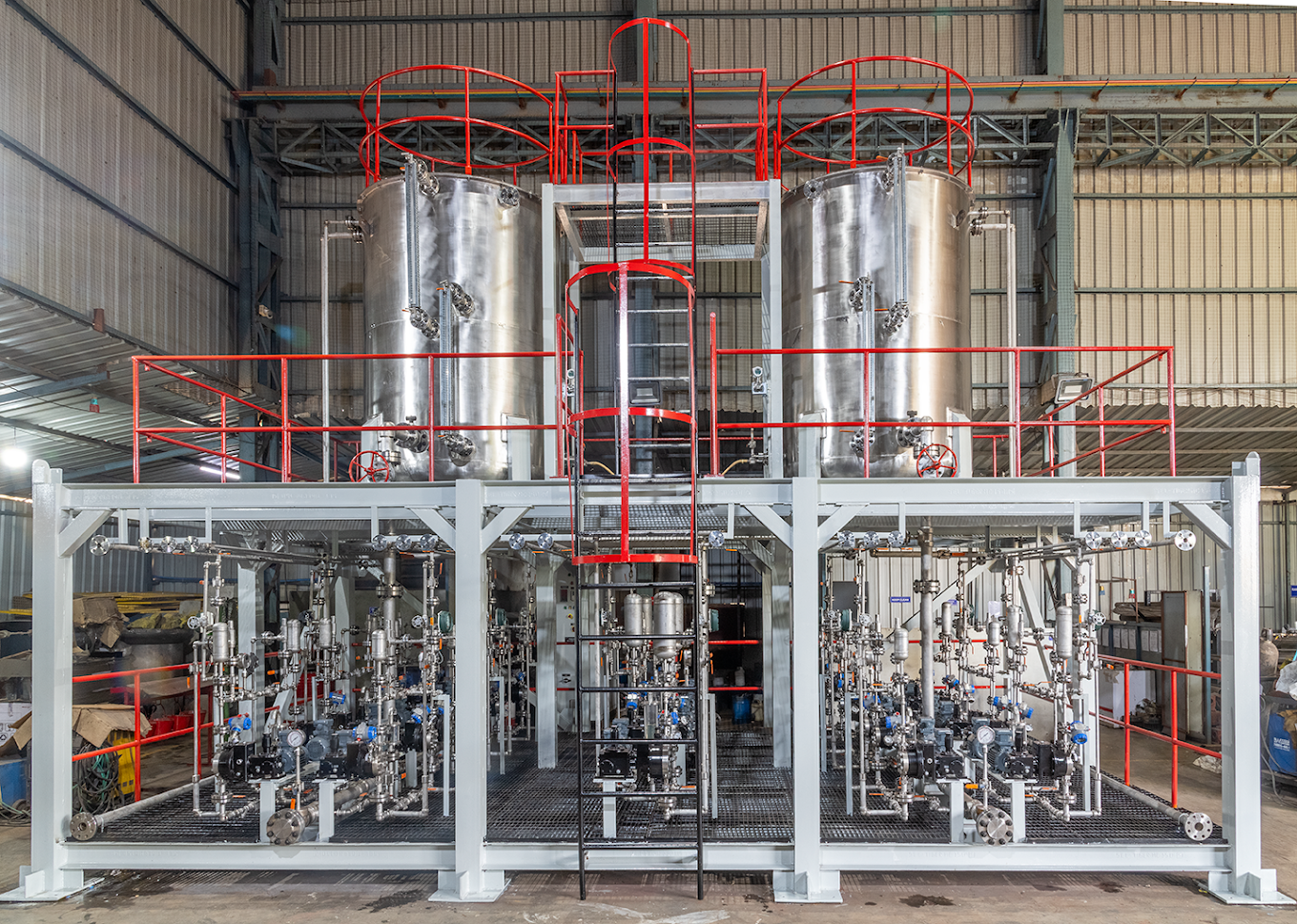
What Is a Polymer Make-Down System?
A polymer make-down system is equipment designed to prepare a usable polymer solution from a concentrated polymer product, such as dry powder or liquid emulsion, by introducing it into water under controlled conditions.
These systems are widely used in wastewater treatment plants, sewage treatment plants (STPs), effluent treatment plants (ETPs), sludge dewatering facilities, and various industrial processes.
Polymers are often used as flocculants to help suspended particles combine into larger flocs. These flocs can then be separated more effectively through clarification, filtration, flotation, or dewatering.
A typical polymer make-down system may include:
Polymer powder feeder or liquid polymer dosing arrangement
Water supply and flow control
Polymer wetting cone or induction equipment
Mixing tank with a suitable agitator
Ageing or maturation tank
Transfer pump and dosing equipment
Level sensors, flow controls, and an automation panel
The exact configuration depends on the polymer type, required solution concentration, process demand, available space, and degree of automation.
1. Polymer Wetting: Preventing Lumps and Uneven Preparation
Wetting is the first critical stage of polymer preparation. It ensures that polymer particles or droplets come into contact with water and disperse properly before the solution proceeds through the hydration or activation process.
When dry polymer powder is introduced incorrectly, its outer surface can hydrate rapidly and form a gel-like layer around dry material. These clumps are commonly called fish eyes.
Fish eyes may contain incompletely hydrated polymer, which can reduce the effectiveness of the prepared solution and cause operational problems.
How to Improve Polymer Wetting
A well-designed wetting arrangement should introduce polymer into a controlled water stream at a suitable feed rate.
Important design considerations include:
Controlled polymer feeding: Introduce powder gradually rather than dumping large quantities into the tank.
Uniform water distribution: Ensure that the polymer contacts water consistently during initial mixing.
Suitable induction equipment: Use a wetting cone, eductor, or another compatible dispersion arrangement where appropriate.
Correct feed ratio: Match polymer addition and water flow to the required preparation concentration.
Moisture protection: Store dry polymer according to supplier recommendations and prevent premature moisture exposure.
For liquid emulsion polymers, the preparation arrangement may require controlled dilution and dispersion to support inversion and activation. The equipment and procedure should follow the specific polymer manufacturer's recommendations.
Why Is Proper Wetting Important?
Effective wetting reduces the formation of lumps, promotes more uniform preparation, and helps prevent undissolved material from entering downstream equipment.
It also helps operators distinguish preparation problems from issues caused by polymer selection, process chemistry, or dosing settings.
2. Polymer Ageing: Allowing Sufficient Hydration Time
After initial wetting and dispersion, many polymers require additional time for hydration and molecular-chain development. This stage is commonly known as polymer ageing or maturation.
During ageing, the prepared polymer develops the properties needed for its intended application. Depending on the polymer formulation and preparation conditions, this can include changes in viscosity and the ability to support particle bridging and floc formation.
Insufficient ageing may result in a solution that has not reached its intended performance, even if the correct quantity of polymer has been added.
How Does Polymer Ageing Work?
Once the polymer has been wetted and dispersed, it is held under suitable conditions for the required maturation period.
The ageing process depends on several factors:
Polymer chemistry and molecular characteristics
Dry powder versus liquid emulsion formulation
Preparation concentration
Water quality and temperature
Mixing intensity
Manufacturer-recommended activation time
There is no single ageing time that is correct for every polymer. The required period should be established using supplier guidance and, where necessary, representative testing.
Single-Tank vs. Multi-Chamber Design
Polymer preparation systems can use batch tanks or continuous and multi-chamber arrangements.
Single-tank systems prepare polymer in batches. The tank is filled, the polymer is introduced and mixed, and the solution is held until it is ready for use. This arrangement may suit applications with predictable batch requirements.
Multi-chamber systems separate preparation and maturation into different stages. One chamber can support initial wetting and mixing, while subsequent chambers provide additional ageing and storage capacity.
A multi-chamber system can support a more continuous supply of prepared polymer when designed around the required flow rate and maturation period.
How to Size an Ageing Tank
Ageing capacity should be based on actual polymer solution consumption and the required residence time.
A preliminary estimate is:
Required working volume = Solution consumption rate × Required ageing time
For example, if a process consumes 200 litres per hour of prepared polymer solution and requires 30 minutes of ageing, the theoretical working volume for that residence period is:
200 L/h × 0.5 h = 100 litres.
This is a simplified estimate, not a final tank specification. The design must account for usable tank volume, actual residence-time distribution, operating levels, mixing requirements, batch cycles, and the polymer supplier's recommendations.
3. Shear Control: Protecting Polymer Performance
Shear is the mechanical stress experienced by a fluid as it moves through mixers, pumps, valves, and pipes.
During polymer preparation, mixing energy is necessary to distribute and hydrate the material. However, excessive or prolonged mechanical stress can damage the long molecular chains of certain polymers, potentially reducing their effectiveness in flocculation.
The objective is not to eliminate mixing. It is to provide the right mixing intensity at each stage.
Why Can Excessive Shear Be a Problem?
High shear may occur in unsuitable mixers, high-speed recirculation loops, restrictive valves, narrow pipework, or poorly selected transfer equipment.
Depending on the polymer and operating conditions, excessive shear can contribute to:
Reduced floc formation
Changes in solution viscosity or performance
Inconsistent treatment results
Higher polymer consumption when operators compensate for poor performance
Reduced efficiency in sludge thickening or dewatering
These symptoms are not proof of shear damage on their own. Polymer quality, water chemistry, ageing time, concentration, and process conditions should also be checked.
How to Minimise Shear in Polymer Systems
A shear-conscious design should consider the entire polymer preparation and delivery path.
1. Select a suitable agitator
Use an agitator designed for the required mixing duty. After the initial dispersion stage, gentle and uniform mixing may be more appropriate than continuous high-intensity agitation.
2. Avoid unnecessary recirculation
Repeated circulation through high-shear equipment can expose the polymer to additional mechanical stress. Use recirculation only when justified by the process design.
3. Select a compatible transfer pump
Progressive cavity pumps are often considered for viscous polymer solutions because they can provide controlled, low-pulsation transfer when correctly selected and operated. Other pump types may also be suitable depending on the solution, duty, and manufacturer's guidance.
4. Review pipework and valves
Avoid unnecessary restrictions, unsuitable valve arrangements, and excessive pressure losses. Assess pipe diameter, flow velocity, fittings, and the injection point as part of the system design.
5. Match mixing intensity to each stage
Initial wetting may require sufficient energy for dispersion, while subsequent maturation should avoid unnecessary shear. The correct arrangement depends on the polymer formulation and equipment.
4. Polymer Concentration and Water Quality
Polymer concentration and make-up water quality directly influence preparation performance.
A solution that is too concentrated may become difficult to mix, transfer, and distribute uniformly. Conversely, a very dilute solution may require larger storage tanks and greater handling capacity.
The appropriate concentration depends on the product, process requirements, equipment, and supplier recommendations.
Water quality should also be assessed. Temperature, hardness, pH, dissolved substances, and other water characteristics can influence polymer preparation or performance, depending on the formulation.
For reliable operation:
Follow the polymer supplier's recommended preparation concentration.
Maintain consistent water flow and polymer feed rates.
Check whether the make-up water is compatible with the selected polymer.
Monitor solution appearance and viscosity as useful operational indicators.
Avoid assuming that a clear or uniform-looking solution is necessarily fully activated.
The prepared solution's usable storage period should also follow supplier guidance and actual operating conditions. Holding polymer solution for longer than recommended may affect performance.
5. Integrating the Polymer Make-Down System with Dosing Equipment
Preparing a suitable polymer solution is only one part of the process. The prepared solution must also be transferred and dosed at the required rate and at an appropriate injection point.
A complete polymer preparation and dosing arrangement may combine the make-down tank, transfer pump, dosing pump, flow instrumentation, injection assembly, and control panel.
Important considerations include:
Required polymer solution flow rate
Dosing accuracy and turndown requirements
Operating pressure and pipework layout
Compatibility with the polymer's viscosity and chemistry
Manual or automatic control requirements
Integration with the plant's PLC or other automation equipment
For wastewater treatment and sludge dewatering, the dosing rate may need to respond to process flow, solids loading, or treatment performance. The appropriate control strategy should be established from process data and validated through testing.
6. Common Polymer Make-Down Problems and Their Solutions
| Observed problem | Possible cause | What to check |
|---|---|---|
| Gel lumps or fish eyes | Poor initial wetting or excessive powder feed | Feeder settings, water flow, and wetting equipment |
| Inconsistent solution viscosity | Variable concentration, incomplete hydration, or changing water quality | Polymer feed calibration, ageing conditions, and water characteristics |
| Weak floc formation | Polymer selection, preparation, dosing, or process chemistry issues | Jar tests, preparation records, and dosing rate |
| Performance decreases after transfer | Possible shear damage or changes in solution condition | Pumps, valves, recirculation, and pipework |
| Irregular polymer consumption | Changing process load, solution concentration, or dosing control | Flow measurements, polymer calibration, and process demand |
| Supply interruptions | Insufficient preparation or storage capacity | Consumption rate, ageing volume, and batch sequence |
Troubleshooting should begin with measurements and controlled tests rather than automatically increasing polymer dosage. Excessive dosing can increase operating costs and may negatively affect downstream treatment.
7. Polymer Make-Down System Design Checklist
Before selecting or specifying a polymer preparation system, consider the following points:
Identify whether the polymer is supplied as dry powder, liquid emulsion, or another formulation.
Confirm the required solution concentration and consumption rate.
Establish the recommended wetting, mixing, and ageing conditions.
Size the preparation and ageing capacity around actual process demand.
Select compatible agitators, pumps, valves, and pipework.
Evaluate make-up water quality.
Define instrumentation, level controls, and automation requirements.
Provide safe access for chemical handling, cleaning, and maintenance.
Establish routine monitoring and calibration procedures.
Verify system performance under representative operating conditions.
A properly engineered system should balance preparation quality, throughput, operating reliability, chemical consumption, and maintenance requirements.
Frequently Asked Questions (FAQs)
1. What is a polymer make-down system used for?
A polymer make-down system prepares polymer solutions for applications such as wastewater treatment, sludge dewatering, clarification, and industrial solids separation.
2. Why is wetting important in polymer preparation?
Proper wetting helps disperse polymer particles or droplets and reduces the formation of gel lumps or fish eyes that can interfere with uniform hydration and treatment performance.
3. What is polymer ageing?
Polymer ageing, also called maturation, is the period during which a prepared polymer solution develops the properties required for effective use. The required time depends on the polymer formulation and preparation conditions.
4. How does shear affect polymer performance?
Excessive mechanical stress can damage the molecular chains of susceptible polymers, potentially reducing flocculation performance. Suitable mixing, transfer equipment, and pipework help minimise unnecessary shear.
5. Which pump is suitable for polymer dosing?
The appropriate pump depends on solution viscosity, required flow rate, operating pressure, dosing accuracy, and polymer characteristics. Progressive cavity and compatible metering pumps may be suitable for different duties.
6. How do I determine the capacity of a polymer ageing tank?
A preliminary estimate is obtained by multiplying the prepared-solution consumption rate by the required ageing time. Final sizing must also consider usable volume, residence-time distribution, batch operation, and supplier recommendations.
7. Where are polymer preparation and dosing systems used?
They are used in wastewater treatment plants, sewage treatment plants, effluent treatment plants, sludge dewatering systems, and other industrial processes that require polymer-assisted separation.
Conclusion
Effective polymer make-down system design depends on balancing three important factors: proper wetting, sufficient ageing, and controlled shear. Each stage contributes to preparing a consistent polymer solution that can perform effectively in the intended treatment process.
By selecting suitable preparation equipment, maintaining the correct concentration, allowing the required maturation time, and minimising unnecessary mechanical stress during transfer, industrial facilities can improve process consistency and make more effective use of treatment chemicals.
Looking for a polymer preparation or chemical dosing solution for your industrial application? Visit Unique Dosing Systems Pvt. Ltd. to explore the available dosing solutions and discuss your application requirements with the team.