
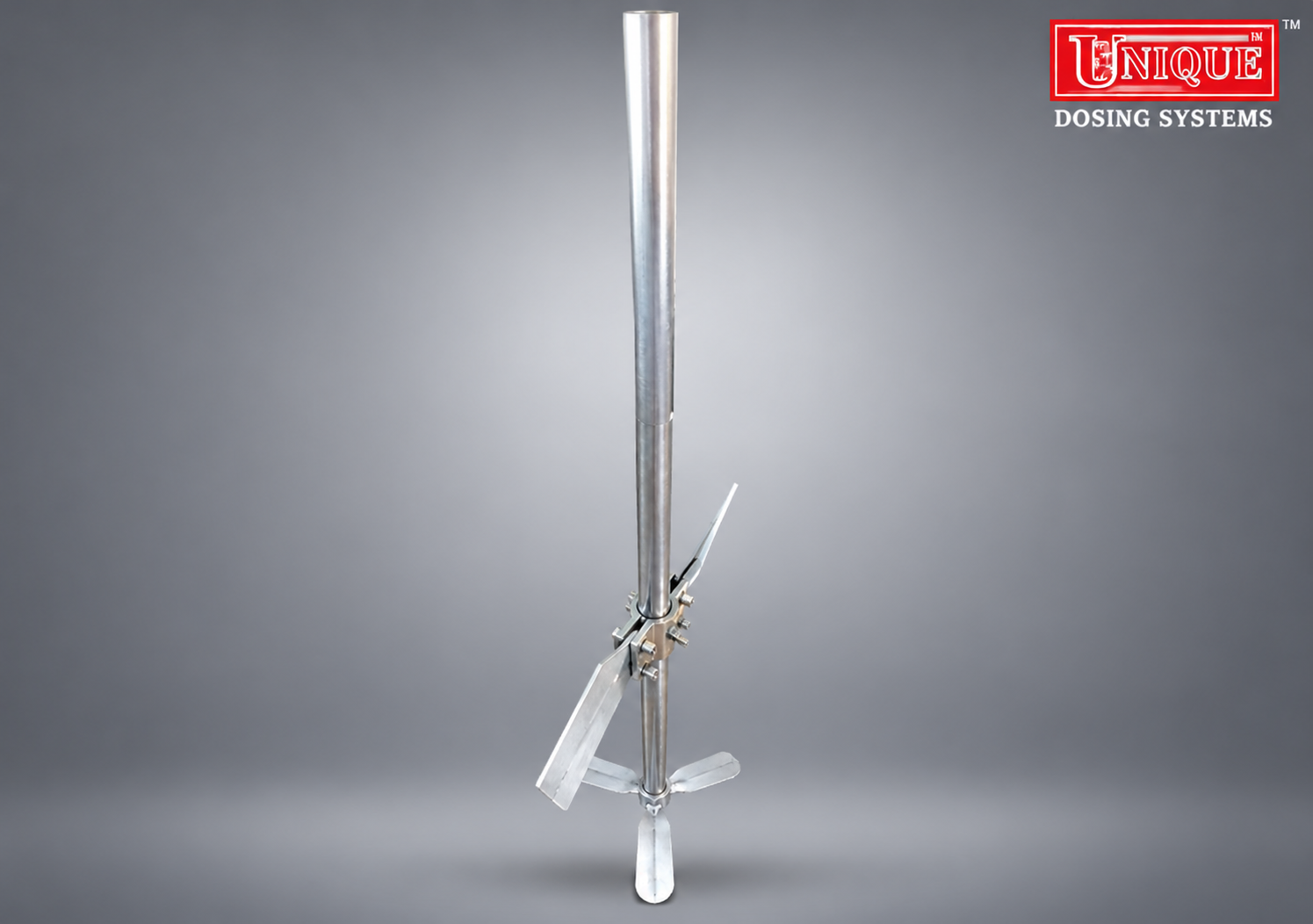
In industries that handle chemicals, water treatment, pharmaceuticals, food processing, and wastewater management, achieving a uniform mixture is essential for maintaining product quality and process efficiency. Blend Time in Industrial Agitators is an important performance factor because it indicates how long an agitator takes to achieve a consistent mixture throughout a tank.
Reducing blend time can improve production efficiency, lower energy consumption, and support reliable process control. This blog explains what blend time means, the factors that influence it, and practical ways to reduce it in industrial mixing applications.
What Is Blend Time in Industrial Agitators?
Blend time is the time required for an agitator to distribute a material throughout a mixing vessel until the mixture reaches a specified level of uniformity.
For example, when a chemical is added to a water tank, the agitator must distribute it evenly throughout the liquid. The time required to achieve the desired concentration uniformity is known as blend time.
Blend time may vary depending on the liquid properties, tank design, agitator configuration, operating speed, and method of chemical addition.
Why Is Blend Time Important?
Optimizing blend time can provide several benefits for industrial operations:
Improved product quality: Helps achieve consistent concentration and composition.
Higher production efficiency: Reduces the time required for each mixing cycle.
Lower operating costs: Can reduce unnecessary agitation and energy use.
Reliable chemical treatment: Supports uniform distribution of treatment chemicals.
Better process control: Helps maintain consistent operating conditions.
Reduced material waste: Minimizes the risk of poorly mixed batches or inconsistent results.
In chemical dosing and water treatment applications, proper mixing is especially important because uneven chemical distribution may affect treatment performance.
Factors That Affect Blend Time
1. Agitator Design and Impeller Type
The impeller plays a major role in determining how liquid circulates inside a tank. Different impeller designs create different flow patterns, such as axial flow, radial flow, or a combination of both.
Selecting an impeller suitable for the liquid properties and mixing objective can improve circulation and reduce blend time.
2. Agitator Speed
Increasing agitator speed can improve mixing in some applications by increasing circulation and turbulence. However, operating at excessively high speeds may increase power consumption, cause unwanted air entrainment, or create excessive shear.
The ideal speed should be selected according to the process requirements rather than simply maximizing RPM.
3. Tank Geometry
Tank diameter, liquid height, bottom shape, and internal obstructions can influence mixing performance. Poor tank geometry may create stagnant zones where liquid circulation is limited.
A suitable tank and agitator arrangement helps promote effective circulation throughout the vessel.
4. Liquid Properties
Viscosity, density, and temperature affect how easily a liquid moves and mixes. High-viscosity liquids generally require more mixing energy and may take longer to achieve uniformity.
The agitator must be selected according to the actual process fluid, including any changes in its properties during operation.
5. Chemical Addition Location
The location where a chemical enters the tank can affect how quickly it becomes distributed. Adding chemicals near a strong circulation zone may help improve dispersion, while adding them in a low-flow area may increase blend time.
The dosing point should be evaluated alongside the agitator’s flow pattern.
How to Reduce Blend Time in Industrial Agitators
1. Select the Right Impeller
Choose an impeller that matches the tank dimensions, liquid viscosity, and required mixing performance. The correct impeller can improve circulation and reduce poorly mixed areas.
For difficult mixing applications, engineering evaluation or testing may be required to determine the most suitable configuration.
2. Optimize Agitator Speed
Review the operating speed to determine whether the agitator is providing sufficient circulation without consuming unnecessary energy.
Where appropriate, variable frequency drives (VFDs) can help adjust speed according to process requirements. Speed optimization should be validated through testing or process data.
3. Improve Tank Flow Patterns
Evaluate whether the tank contains dead zones, short-circuit flow paths, or areas with limited circulation. Adjustments to impeller position, tank internals, or baffles may help improve overall mixing.
Baffles can reduce swirling and promote more effective circulation in suitable tank designs.
4. Position the Chemical Dosing Point Correctly
The chemical dosing point should allow the incoming chemical to enter a region where it can be distributed effectively.
For chemical dosing applications, coordinate the dosing pump’s discharge location and dosing rate with the agitator’s circulation pattern. This can help avoid localized high concentrations and improve distribution.
5. Match the Dosing Rate to Mixing Capacity
Adding chemicals faster than the system can distribute them may lead to concentration differences within the tank.
A controlled dosing rate, coordinated with the agitator’s capacity, can support more consistent mixing. The appropriate rate depends on the chemical, process objective, tank volume, and treatment requirements.
6. Maintain the Agitator
Worn impellers, damaged components, incorrect alignment, or motor-related issues can reduce mixing performance.
Regular inspection and maintenance help ensure that the agitator operates as intended and maintains reliable circulation.
7. Measure and Validate Blend Time
Blend time should be evaluated using a suitable method, such as concentration measurements, conductivity testing, tracer studies, or other process-appropriate techniques.
Testing under actual operating conditions helps identify whether changes to speed, impeller design, or dosing location are delivering measurable improvements.
The Role of Chemical Dosing Systems in Mixing Performance
Industrial agitators and chemical dosing systems often work together to achieve the required treatment or production result.
A dosing pump delivers a controlled quantity of chemical, while the agitator distributes that chemical throughout the tank. If dosing and mixing are not properly coordinated, the system may experience uneven concentration, longer processing time, or inconsistent treatment performance.
When designing or optimizing a chemical dosing application, consider:
- Required chemical flow rate and dosing accuracy
- Chemical compatibility with wetted components
- Tank volume and liquid properties
- Agitator type, speed, and circulation pattern
- Chemical injection point
- Required level of concentration uniformity
- Process control and operating conditions
A properly selected dosing pump and a suitable agitation arrangement can support reliable chemical distribution and efficient operation.
Applications Where Blend Time Matters
Blend time is an important consideration in many industrial processes, including:
- Water and wastewater treatment
- Chemical preparation and dilution
- Polymer and coagulant preparation
- Pharmaceutical manufacturing
- Food and beverage processing
- Industrial process chemical mixing
- Cooling water and boiler water treatment
Each application has different mixing requirements, so the agitator and dosing system should be selected based on the specific process.
Conclusion
Blend Time in Industrial Agitators is a key factor in achieving uniform mixing, maintaining product quality, and improving industrial process efficiency. It is influenced by agitator design, operating speed, tank geometry, liquid properties, and chemical addition location.
Blend time can often be reduced by selecting the right impeller, optimizing operating speed, improving tank circulation, coordinating chemical dosing, and validating performance through testing.
For chemical dosing applications, effective coordination between the dosing pump and industrial agitator helps support consistent chemical distribution and reliable process results.
Frequently Asked Questions
What is blend time in an industrial agitator?
Blend time is the time required for an agitator to achieve a specified level of uniformity throughout a mixing vessel.
How can blend time be reduced?
Blend time may be reduced by optimizing impeller design and speed, improving tank circulation, positioning the chemical dosing point effectively, and matching the dosing rate to the mixing capacity.
Does increasing agitator speed always reduce blend time?
No. Higher speed may improve mixing in some applications, but it can also increase energy consumption, shear, or air entrainment. The optimal speed depends on the process.
Why is blend time important in chemical dosing?
Blend time affects how quickly a dosed chemical becomes uniformly distributed. Proper coordination between dosing and agitation can help improve treatment consistency and process efficiency.