
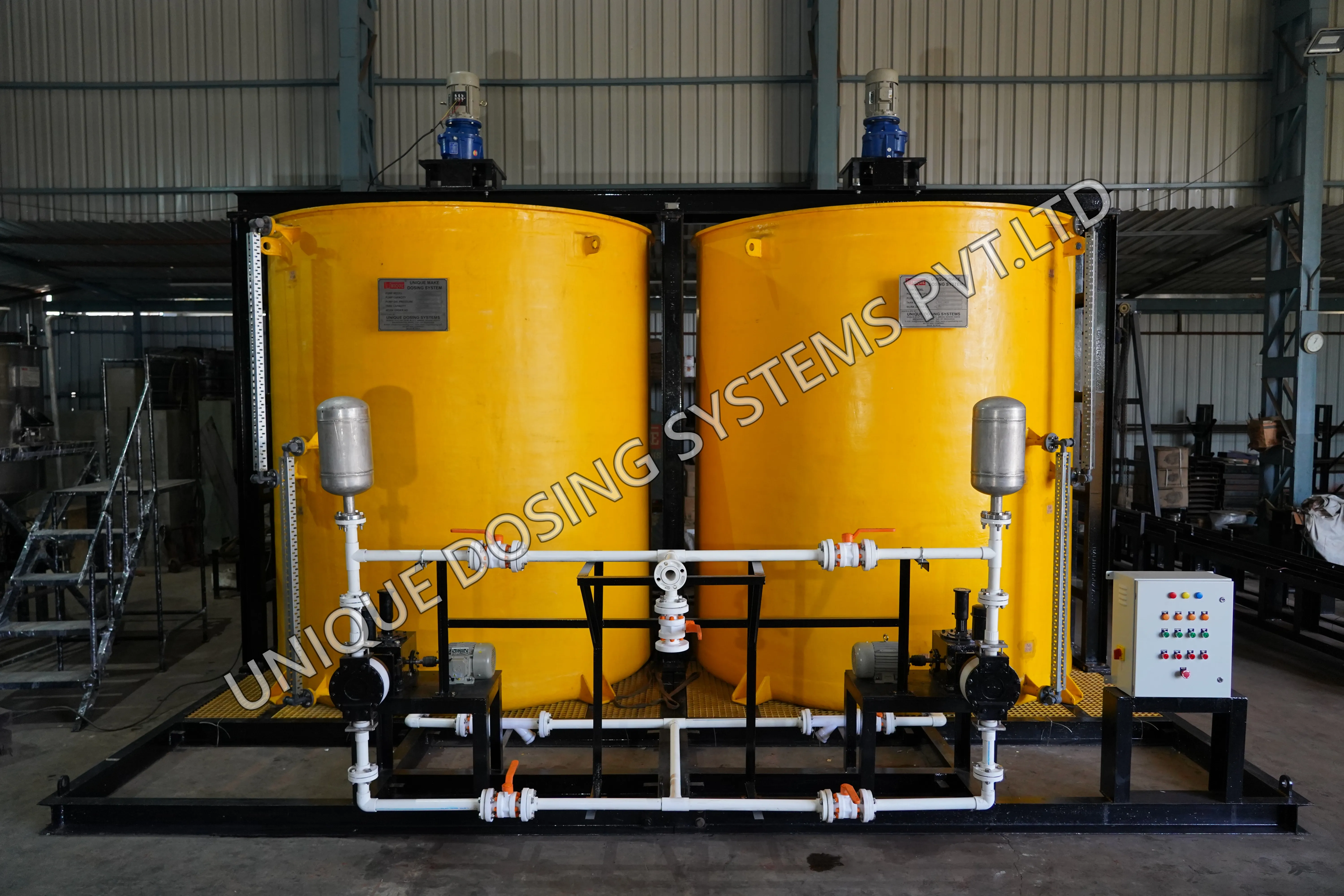
Selecting the correct Dosing Pump Capacity is essential for achieving accurate chemical feed, maintaining process efficiency, and avoiding unnecessary operating costs. An undersized pump may fail to deliver the required chemical quantity, while an oversized pump may create control difficulties and increase equipment costs.
For industrial applications such as water treatment, wastewater treatment, boiler water treatment, and chemical processing, dosing pump selection should be based on the required flow rate, operating pressure, chemical properties, and process conditions.
This guide explains how to calculate dosing pump capacity and select the appropriate litres per hour (LPH) and pressure rating for your application.
What Is Dosing Pump Capacity?
Dosing pump capacity refers to the quantity of liquid a pump can deliver over a specific period under defined operating conditions.
It is commonly expressed as:
- Litres per hour (LPH)
- Litres per day (LPD)
- Millilitres per minute (mL/min)
For example, a dosing pump rated at 10 LPH is designed to deliver a nominal flow of 10 litres per hour under its specified operating conditions. Actual flow may vary depending on discharge pressure, chemical properties, installation, and pump settings.
Important: Flow capacity and pressure rating are related but different specifications. A pump must deliver the required flow rate while operating against the actual system pressure.
Why Is Correct Dosing Pump Capacity Important?
Selecting the right capacity helps to:
- Maintain the required chemical dosage
- Improve treatment and process consistency
- Reduce chemical wastage
- Avoid underdosing or overdosing
- Support reliable process control
- Reduce unnecessary equipment and operating costs
The correct capacity is particularly important in applications where chemical feed must be matched to process flow or maintained within a defined concentration range.
1. Identify the Required Chemical Dosage
Begin by determining how much chemical your process requires.
Chemical dosage may be expressed as:
- mg/L or ppm
- L/h
- L/day
- Percentage concentration
- A defined quantity per batch
For water treatment, the required chemical dosage is often specified in milligrams per litre (mg/L). The process flow rate and chemical concentration are then used to calculate the required chemical feed.
Make sure the dosage value is based on the actual process requirement rather than an assumed or approximate value.
2. Calculate the Required Dosing Pump Flow Rate
For a liquid chemical solution, a useful starting formula is:
[
\text{Chemical Feed (L/h)} =
\frac{\text{Dosage (mg/L)} \times \text{Process Flow (m}^3\text{/h)}}{\text{Chemical Concentration (mg/L)}}
]
This formula assumes the chemical concentration is expressed in compatible units and that the required feed is being calculated on a solution-volume basis. For concentrated chemicals, density and active ingredient concentration may need to be considered.
Example: Dosing Pump Capacity Calculation
Suppose an industrial water treatment system has:
Process flow rate: 100 m³/h
Required chemical dosage: 5 mg/L
Prepared chemical solution concentration: 10,000 mg/L
Using the formula:
[
\text{Feed Rate} =
\frac{5 \times 100}{10{,}000}
= 0.05\text{ m}^3/\text{h}
]
Convert cubic metres per hour to litres per hour:
[
0.05 \times 1000 = 50\text{ L/h}
]
The calculated chemical solution feed rate is 50 LPH.
The selected pump must be capable of delivering this required flow at the actual operating pressure. Final selection should also account for the pump’s controllable range and the process’s minimum and maximum dosing requirements.
3. Convert LPD to LPH When Required
Some applications specify chemical consumption in litres per day (LPD). To convert this value into litres per hour:
[
\text{LPH} = \frac{\text{LPD}}{24}
]
For example, if the required chemical feed is 240 LPD:
[
\frac{240}{24} = 10\text{ LPH}
]
The average required flow rate is 10 LPH.
However, if the pump operates only during certain hours, calculate the required flow based on actual operating time rather than dividing by 24.
4. Select the Right Pressure Rating
After calculating the required flow rate, determine the pressure against which the pump must discharge.
Consider:
- Pressure in the receiving process line
- Static pressure and elevation difference
- Friction losses in the discharge piping
- Pressure losses through valves and accessories
- Injection point and backpressure conditions
The pump’s pressure rating must be suitable for the system’s maximum expected operating pressure.
Why Pressure Matters
A dosing pump rated for a particular flow at low pressure may deliver a different flow when operating against higher pressure. Therefore, pump selection should be based on performance at the required flow rate and discharge pressure together.
Do not select a pump using only its maximum LPH rating.
5. Consider the Chemical Properties
Chemical properties can influence pump performance and the materials required for reliable operation.
Review:
- Chemical compatibility
- Concentration
- Viscosity
- Density
- Temperature
- Corrosiveness
- Presence of solids or particles
For example, a viscous chemical may require a different pump configuration or installation arrangement than a low-viscosity liquid. Wetted materials such as the pump head, diaphragm, valves, and seals must also be compatible with the chemical.
6. Choose the Appropriate Dosing Pump Type
Different pump designs may be suitable for different capacity and pressure requirements.
Diaphragm Dosing Pump
Commonly used for chemical feeding in water treatment and industrial applications. The suitable model depends on the required capacity, pressure, chemical compatibility, and control requirements.
Hydraulic Diaphragm Dosing Pump
May be considered for applications requiring particular pressure, capacity, or process performance characteristics. Selection should be based on the manufacturer’s specified operating range.
Plunger Dosing Pump
Uses a reciprocating plunger to move liquid and may be suitable for certain high-pressure applications, depending on the chemical and process requirements.
Automatic or Controlled Dosing Pump
May provide manual, pulse, 4–20 mA, batch, or PLC-based control, depending on the model. These options can help adjust dosing according to process demand.
7. Account for Minimum and Maximum Dosing Requirements
Industrial processes may not operate at a constant flow rate. A dosing pump may need to handle both minimum and maximum chemical demand.
Before selecting a model, establish:
- Minimum required dosing flow
- Normal operating flow
- Maximum required dosing flow
- Expected process-flow variation
- Required adjustment or control range
The pump should operate reliably across the required range. Choosing a pump with excessive capacity may make low-flow adjustment more difficult, depending on its design and control method.
8. Review Installation Conditions and Accessories
Correct capacity selection also depends on the installation.
Check:
- Suction tank level and suction lift
- Suction pipe diameter and length
- Discharge pipe arrangement
- Injection point pressure
- Required valves and accessories
- Calibration and maintenance access
- Chemical storage and operator safety requirements
Poor suction conditions, air entering the system, or unsuitable accessories can affect actual dosing performance even when the pump’s nominal capacity is appropriate.
Dosing Pump Capacity Selection Checklist
Before requesting a quotation, prepare the following information:
| Parameter | Information Required |
|---|---|
| Chemical name | Exact chemical and concentration |
| Required dosage | mg/L, ppm, L/h, or L/day |
| Process flow | Minimum, normal, and maximum |
| Required pump flow | Calculated LPH |
| Operating pressure | Normal and maximum discharge pressure |
| Chemical properties | Viscosity, density, temperature, compatibility |
| Control method | Manual, pulse, 4–20 mA, batch, or PLC |
| Installation | Suction conditions and injection point |
| Accessories | Valves, calibration equipment, and other requirements |
Providing complete information helps the manufacturer evaluate the application and recommend a suitable dosing pump.
Common Mistakes to Avoid
When calculating Dosing Pump Capacity, avoid these common mistakes:
- Selecting a pump using only its maximum LPH rating
- Ignoring actual discharge pressure
- Using chemical concentration values without checking units
- Assuming the pump operates continuously for 24 hours
- Overlooking minimum dosing requirements
- Ignoring chemical compatibility
- Selecting a pump without reviewing installation conditions
- Adding an arbitrary capacity margin without checking the process requirements
A proper calculation and technical review can help prevent these issues.
Applications of Dosing Pump Capacity Calculation
Correct capacity calculation is important in:
- Water and wastewater treatment
- Boiler water chemical dosing
- Cooling tower treatment
- Reverse osmosis systems
- pH correction
- Chemical preparation and feeding
- Pharmaceutical manufacturing
- Industrial process chemical dosing
Each application has different dosage, flow, pressure, and control requirements.
Conclusion
Accurate Dosing Pump Capacity calculation helps ensure that the required chemical quantity is delivered at the correct flow rate and pressure. To select a suitable pump, determine the chemical dosage, calculate the required LPH, evaluate the operating pressure, and consider chemical properties, control range, and installation conditions.
For reliable industrial operation, the selected dosing pump should be capable of delivering the required flow under actual system conditions—not simply meet a nominal capacity rating.
Unique Dosing Systems Pvt. Ltd., based in Nashik, Maharashtra, India, provides dosing pump and chemical dosing system solutions for industrial applications. Share your chemical details, required dosage, process flow, and operating pressure to help identify a suitable dosing solution.
Frequently Asked Questions
How do I calculate dosing pump capacity in LPH?
For a liquid chemical solution, use the required dosage and process flow rate along with the solution concentration. Ensure all units are compatible before calculating the required feed rate.
What does 10 LPH mean in a dosing pump?
10 LPH means a nominal delivery capacity of 10 litres per hour under the pump’s specified operating conditions.
How do I select the pressure rating of a dosing pump?
Evaluate process pressure, elevation, piping losses, valves, and injection point conditions. Select a pump rated for the required operating pressure and flow rate together.
Can a higher-capacity dosing pump always be used?
Not necessarily. An oversized pump may be difficult to control at low flow rates and may increase equipment costs. Select a pump that matches the required operating range.
What information is needed to select a dosing pump?
You generally need the chemical name and concentration, required dosage, process flow, operating pressure, temperature, chemical properties, control method, and installation details.