In industrial applications, accurate chemical dosing is essential for maintaining process efficiency, product quality, and operational safety. Whether it is water treatment, wastewater management, chemical processing, or manufacturing, selecting the right dosing equipment requires a clear understanding of its technical specifications.
A Dosing System Datasheet provides essential information about the performance, configuration, and operating requirements of a chemical dosing system. It helps engineers, plant operators, and procurement professionals evaluate equipment and determine whether it meets their application requirements.
In this guide, we will explain the key parameters of a dosing system datasheet, its importance, and how to select the right chemical dosing system for your industrial application.
What Is a Dosing System Datasheet?
A dosing system datasheet is a technical document that provides detailed information about the specifications, components, operating conditions, and performance characteristics of a dosing system.
It typically includes details such as:
- Chemical dosing capacity and flow rate
- Operating and maximum discharge pressure
- Pump type and operating principle
- Chemical compatibility and material of construction
- Motor power and electrical requirements
- Control system and automation features
- Tank capacity and system configuration
- Installation and operating conditions
A properly prepared datasheet allows buyers and technical teams to compare different dosing systems and make informed equipment selection decisions.
Why Is a Dosing System Datasheet Important?
Reviewing a dosing system datasheet before purchasing equipment helps ensure that the selected system is suitable for the intended application.
1. Accurate Chemical Dosing
The datasheet specifies the dosing capacity and operating range of the pump. This information helps engineers select equipment capable of delivering the required chemical quantity accurately.
2. Chemical Compatibility
Different chemicals require different materials of construction. Reviewing the wetted parts, diaphragm, seals, valves, and piping materials helps prevent corrosion, leakage, and premature equipment failure.
3. Operational Efficiency
Selecting a dosing system based on its actual operating conditions can improve process efficiency, reduce unnecessary energy consumption, and support reliable operation.
4. Easy Equipment Comparison
A datasheet provides standardized technical information that helps procurement teams compare different dosing pump manufacturers and identify the most suitable solution.
5. Maintenance and Reliability
Technical specifications help maintenance teams understand equipment requirements, operating limitations, and replacement component details.
Key Technical Specifications in a Dosing System Datasheet
Understanding the following parameters is essential when evaluating a chemical dosing system.
1. Flow Rate or Dosing Capacity
Flow rate indicates the quantity of chemical that a dosing pump can deliver over a specific period.
It is commonly expressed in:
- Litres per hour (LPH)
- Millilitres per minute (mL/min)
- Litres per minute (LPM)
For example, a dosing pump rated at 100 LPH can deliver up to 100 litres of liquid per hour under its specified operating conditions.
The required dosing capacity depends on chemical concentration, process demand, and application requirements.
2. Discharge Pressure
Discharge pressure refers to the pressure against which the dosing pump operates while delivering the chemical.
It is generally expressed in bar, kg/cm², or PSI.
The selected pump must be capable of delivering the required flow rate at the actual system operating pressure. Engineers should verify the pump performance at the specified pressure rather than relying only on its maximum rated capacity.
3. Material of Construction
Material selection is important for ensuring chemical compatibility and long-term equipment reliability.
Common materials include:
| Component | Common Materials |
|---|---|
| Pump head | PVC, PP, PVDF, SS316 |
| Diaphragm | PTFE or compatible elastomers |
| Valve components | Ceramic, SS316, PTFE |
| Tank | HDPE, PP, FRP |
| Piping | PVC, PP, PVDF, SS316 |
The appropriate material depends on the chemical being dosed, its concentration, temperature, pressure, and operating conditions.
4. Pump Type
A dosing system datasheet should identify the type of dosing pump used in the system.
Common types include:
Diaphragm Dosing Pump: Suitable for accurate chemical metering in various industrial applications.
Hydraulic Diaphragm Dosing Pump: Uses hydraulic actuation to operate the diaphragm and is suitable for demanding dosing applications.
Plunger Dosing Pump: Uses reciprocating plunger movement to deliver liquid at controlled flow rates.
Mechanical Dosing Pump: Uses mechanical drive arrangements for chemical metering.
Electromagnetic Dosing Pump: Uses electromagnetic actuation and is commonly used for lower-capacity dosing applications.
The appropriate pump type depends on the required capacity, pressure, chemical properties, and control requirements.
5. Motor and Power Requirements
For motor-driven dosing systems, the datasheet should specify:
- Motor power rating
- Supply voltage
- Frequency
- Phase
- Motor speed
- Protection rating
These details help ensure compatibility with the electrical infrastructure available at the installation site.
6. Control and Automation Features
Modern chemical dosing systems may include different control and automation options.
- Common features include:
- Manual flow adjustment
- 4–20 mA signal control
- Pulse-based dosing
- Batch dosing
- PLC-based automation
- Level switches
- Flow monitoring
- Pressure monitoring
- Remote monitoring and control
The required control configuration depends on the process automation level and the dosing accuracy needed.
Components Included in a Chemical Dosing System
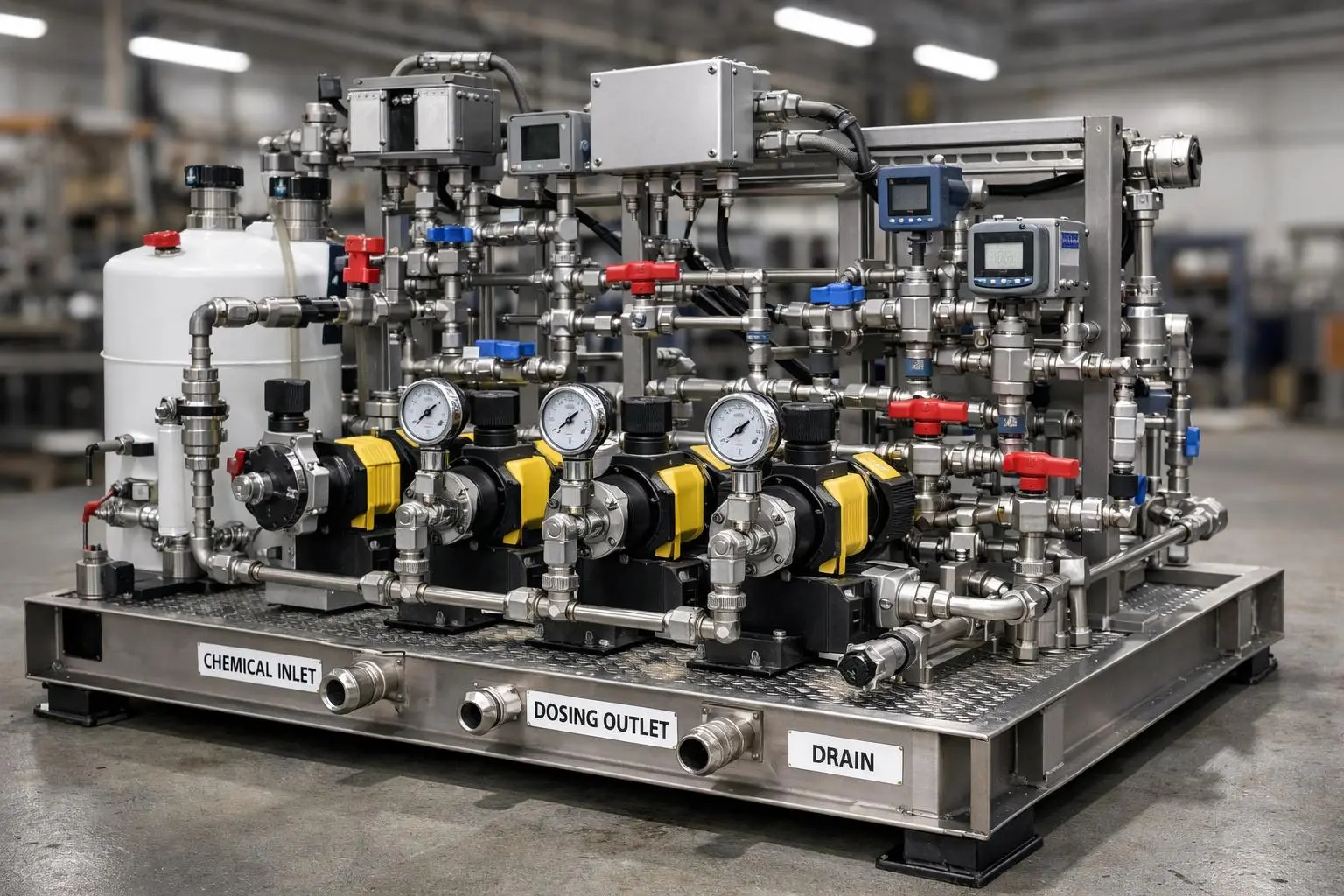
A chemical dosing system may consist of several integrated components designed to provide controlled and reliable chemical delivery.
| Component | Function |
|---|---|
| Dosing pump | Accurately delivers the required chemical quantity |
| Chemical storage tank | Stores the chemical solution |
| Agitator | Helps maintain solution uniformity where required |
| Calibration pot | Supports flow verification and calibration |
| Injection valve | Introduces the chemical into the process line |
| Back pressure valve | Helps maintain stable operating conditions |
| Pressure relief valve | Provides protection against excessive pressure |
| Piping and fittings | Transport chemicals between system components |
| Control panel | Provides operational control and monitoring |
The final configuration depends on the chemical, process requirements, installation conditions, and customer specifications.
How to Select the Right Dosing System Using a Datasheet
Selecting a suitable dosing system requires evaluating the application requirements before choosing the equipment.
Step 1: Identify the Chemical
Determine the chemical name, concentration, temperature, viscosity, and compatibility requirements.
Step 2: Determine the Required Flow Rate
Calculate the required dosing quantity based on process demand and chemical consumption.
Step 3: Identify Operating Pressure
Determine the pressure at the injection point and account for the relevant system operating conditions.
Step 4: Select the Appropriate Pump Type
Choose a pump based on the required flow rate, pressure, chemical properties, and operating conditions.
Step 5: Verify Material Compatibility
Confirm that all wetted components are suitable for the chemical being handled.
Step 6: Define Control Requirements
Determine whether the application requires manual operation, automatic flow control, batch dosing, or integration with a PLC or other control system.
Step 7: Review the Complete Datasheet
Verify that the pump, tank, accessories, control panel, and other system components meet the project requirements.
Common Mistakes to Avoid When Reviewing a Dosing System Datasheet
When selecting chemical dosing equipment, avoid these common mistakes:
- Selecting a pump based only on maximum flow rate
- Ignoring discharge pressure requirements
- Overlooking chemical compatibility
- Choosing unsuitable diaphragm or seal materials
- Ignoring minimum and maximum operating conditions
- Failing to specify control and automation requirements
- Overlooking installation and maintenance requirements
- Comparing equipment without checking the complete system configuration
A detailed technical review helps reduce equipment selection errors and supports reliable long-term operation.
Frequently Asked Questions About Dosing System Datasheets
What information is included in a dosing system datasheet?
A dosing system datasheet generally includes flow rate, discharge pressure, pump type, material of construction, motor specifications, control features, and system components.
Why is a chemical dosing pump datasheet important?
It helps engineers verify whether the pump can handle the required chemical, deliver the necessary flow rate, and operate under the specified pressure and process conditions.
How do I select a dosing pump using its datasheet?
Review the chemical properties, required flow rate, operating pressure, material compatibility, control requirements, and operating conditions before selecting the pump.
What is the difference between a dosing pump datasheet and a dosing system datasheet?
A dosing pump datasheet focuses on the individual pump's technical specifications. A dosing system datasheet may cover the complete integrated system, including the pump, tank, accessories, piping, and control panel.
Can a dosing system be customized for industrial applications?
Yes. Chemical dosing systems can be configured according to application requirements, including chemical properties, dosing capacity, operating pressure, material compatibility, and automation needs.
Conclusion
A Dosing System Datasheet is an essential technical reference for selecting reliable and efficient chemical dosing equipment. Understanding parameters such as flow rate, discharge pressure, material of construction, pump type, and automation features helps engineers and procurement teams make informed decisions.
Selecting the right dosing system requires more than comparing pump capacities. It involves evaluating the complete application and ensuring that every component meets the required operating conditions.
Unique Dosing Systems Pvt. Ltd. provides chemical dosing pumps, metering pumps, dosing systems, and chemical dosing skids for various industrial applications. If you are looking for a dosing solution suited to your process requirements, contact our technical team to discuss your application and request the relevant technical specifications.
Visit Unique Dosing Systems to explore our range of chemical dosing solutions.